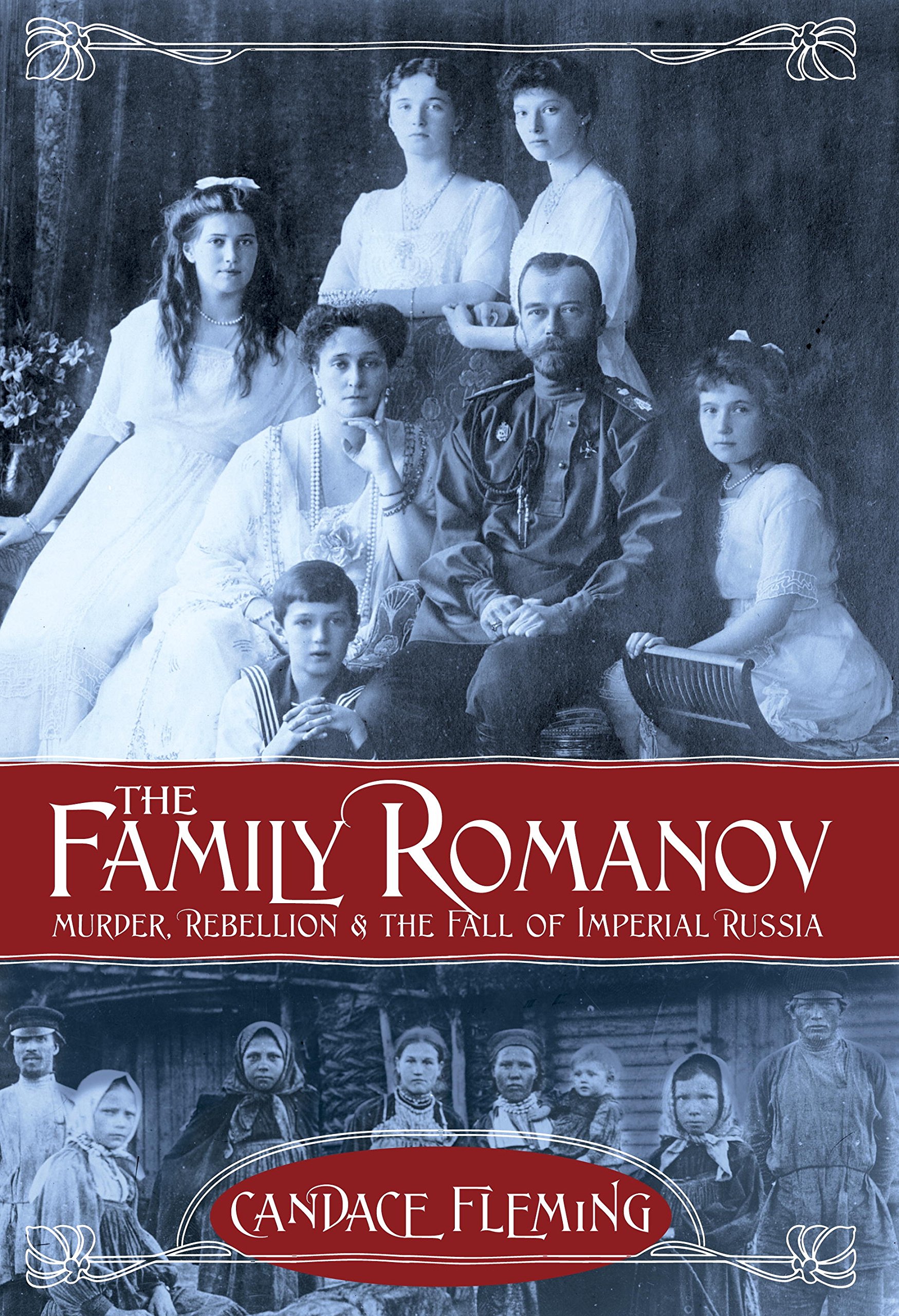
The Family Romanov: Part Four
This award-winning book traces the history of the last royal family to rule Russia, the Romanovs.
Here are links to our lists for the book: Russia, 1903–Beyond the Palace Gates; Part One; Part Two; Part Three; Part Four
40 words
198 learners
Learn words with Flashcards and other activities
Definition First

Other learning activities
Full list of words from this list:
-
revel
take delight inOtherwise, he reveled in spending time with his family and having “plenty of [hours] to read for my own pleasure.”
-
gaunt
very thin, especially from disease or hunger or coldNow the family had the sickly Alexandra back. Her features suddenly aged and gaunt, her hair almost completely gray, she constantly grumbled about the hardships imposed on the family.
-
livery
a uniform, especially worn by servants and chauffeursFootmen in elaborate livery still bowed and served meals; expensive wines from the imperial cellar still appeared on the table; maids still came to help her change into lace gowns and lengths of pearls.
-
denounce
speak out againstAngry mobs carrying guns and banners denounced the foreign minister.
-
hypocritical
professing feelings or virtues one does not haveThey declared the government deceitful and hypocritical.
-
indomitable
impossible to subdueRecalled one soviet member, “[Lenin] was followed unquestioningly as [the Bolsheviks’ chosen] leader...a man of iron will and indomitable energy, capable of instilling fanatical faith in the movement and the cause.”
-
rout
an overwhelming defeatThe offensive began in early July and soon turned into a rout, not for the Austrians and the Germans who helped them, but for the Russians, as hundreds of thousands of peasant soldiers were killed.
-
cad
someone who is morally reprehensible“Behave like gentlemen, not like cads,” he advised them.
-
placard
a sign posted in a public placeKnowing he could not transport the family in their easily recognizable blue imperial train, he had an ordinary one fitted out with Japanese flags and placards that read “Japanese Red Cross Mission.”
-
forlorn
marked by or showing hopelessnessAlready, the rooms felt empty, the dustcloth-covered furniture looking like forlorn ghosts.
-
detritus
the remains of something that has been destroyed or finishedNow the Romanovs sat among the detritus of their lives, and waited.
-
copious
large in number or quantityHe found the grand duchesses huddled together “weeping copiously” while the tsar stood at one of the windows stonily smoking cigarette after cigarette.
-
stoic
seeming unaffected by pleasure or pain; impassiveEven the usually stoic Alexandra was affected by the nerve-racking delay.
-
earnest
characterized by a firm, sincere belief in one's opinionsEighteen-year-old Marie, however, was as earnest and open as ever.
-
coup
a sudden and decisive change of government by forceBut the October Revolution was a well-organized and quiet coup.
-
monotony
the quality of wearisome constancy and lack of varietyAt first, the new Bolshevik-controlled government had little effect on the Romanovs, and their days went on as before—meals, books, card games...boredom! Then winter roared in, bringing both snow and a break in the monotony.
-
affront
a deliberately offensive actThey demanded that Nicholas remove his officer’s epaulets from his uniforms and jackets. Since they bore his father’s monogram, their forced removal was a deep affront to the entire family.
-
anoint
choose by or as if by divine interventionAs they marched, former landowners and factory owners angry over Bolshevik seizure of their property joined them. So did devout members of the Russian Orthodox Church who still believed the tsar was God anointed; supporters of the Provisional Government who wanted democracy rather than communism; and twenty-five thousand Czech prisoners of war who were fighting their way out of Russia in hopes of being reunited with Czech troops on the front.
-
indignantly
in a manner showing anger at something unjust or wrong“To think they called [Alexandra] a traitor,” he cried indignantly one moment, only to moan in the next, “How much longer will our unfortunate motherland be torn and ripped apart?"
-
haggard
showing the wearing effects of overwork or care or sufferingThe sight of the former heir lying so still in his bed shook the commissar. “The yellow-complexioned, haggard boy seemed to be passing away,” he later wrote.
-
wanton
indulgent in immoral or improper behavior“The dresses...of wanton women,” shrieked a woman, pointing toward the train.
-
valise
a small overnight bag for short trips“Nagorny the sailor...passed my window, carrying the sick [Alexei] in his arms; behind him came the grand duchesses, loaded with valises and small personal belongings....Tatiana Nikolaevna came last, carrying her little dog and struggling to drag a heavy brown valise. It was raining, and I saw her feet sinking into the mud at every step.”
-
haphazardly
without care; in a slapdash mannerInstead, their luggage had been tossed unopened and haphazardly into a storage shed located behind the house.
-
zealous
marked by active interest and enthusiasmWhen the revolution came, he backed the Bolsheviks with zealous enthusiasm, rising up quickly through the party ranks.
-
liquidate
get rid of by killingNicholas had to be “liquidated” before the city fell. But Lenin and other high-ranking Bolsheviks in Moscow refused to authorize an execution.
-
adamant
impervious to pleas, persuasion, requests, or reasonEven though most officials believed Alexandra was to blame for much of the country’s disintegration, they had no intention of charging her—or the children—with any crimes. Lenin was adamant on this last point.
-
vehemently
in a forceful mannerHe vehemently opposed murdering the entire imperial family, not because he cared what happened to them but because he believed it would have a bad effect on public opinion across Russia and abroad.
-
liturgy
a rite or body of rites prescribed for public worshipCrossing his arms over his chest, he never took his eyes off the group as the priest moved through the liturgy.
-
balk
refuse to proceed or complyBut when Yurovsky explained what was expected of them, at least two of the men balked.
-
elicit
call forth, as an emotion, feeling, or responseAnd rumors that the rest of the family had been killed didn’t elicit much emotion either.
-
conscription
compulsory military serviceCitizens became subject to “labor conscription”; that is, they had to work where, when, and at what the government told them.
-
disillusioned
freed from false ideasDisillusioned by the treatment workers and peasants had received under Lenin’s dictatorship, they took to the streets, demanding freedoms the soviet government had taken away: free elections, free speech, freedom of the press, free trade unions, and freedom for the peasants to harvest their own land for their own benefit.
-
purge
an abrupt or sudden removal of a person or groupHe immediately embarked on what he called a purge, eliminating all his old Bolshevik friends and rivals by exile, execution, or assassination.
-
tedium
the feeling of being bored by somethingBut here too I had no luck: there was a long [line] of hopeful eaters, tedium and vexation written on their faces; the [line] was not moving at all....
-
vexation
anger produced by some annoying irritationBut here too I had no luck: there was a long [line] of hopeful eaters, tedium and vexation written on their faces; the [line] was not moving at all....
-
poignant
arousing powerful emotions, especially pity or sadnessIn a poignant twist, this same series of tests also identified one of the grand duchesses as being a carrier of hemophilia.
-
inter
place in a grave or tombMost agreed they should be buried in the Cathedral of Saints Peter and Paul in St. Petersburg, where all tsars since Peter the Great had been buried. But there were some touchy issues to sort out first. Should the whole family be interred together?
-
relegate
assign to a lower positionTraditionally, only the tsar and his wife were given tombs in the central part of the cathedral, while children were relegated to spots farther back.
-
ambivalent
uncertain or unable to decide about what course to followA year later, they concluded that neither Nicholas nor his family deserved sainthood. “His life, his actions...all of this is regarded by the Church and Society in a very ambivalent way,” explained one church leader.
-
cupola
a roof or part of a roof in the form of a domeBuilt in the Russian style, each with its own gold cupola and green roof, they are individual shrines, one for each of the now haloed Romanovs.
Created on 十月 14, 2020
(updated 十月 26, 2020)
Sign up now (it’s free!)
Whether you’re a teacher or a learner,
Vocabulary.com can put you or your class
on the path to systematic vocabulary improvement.