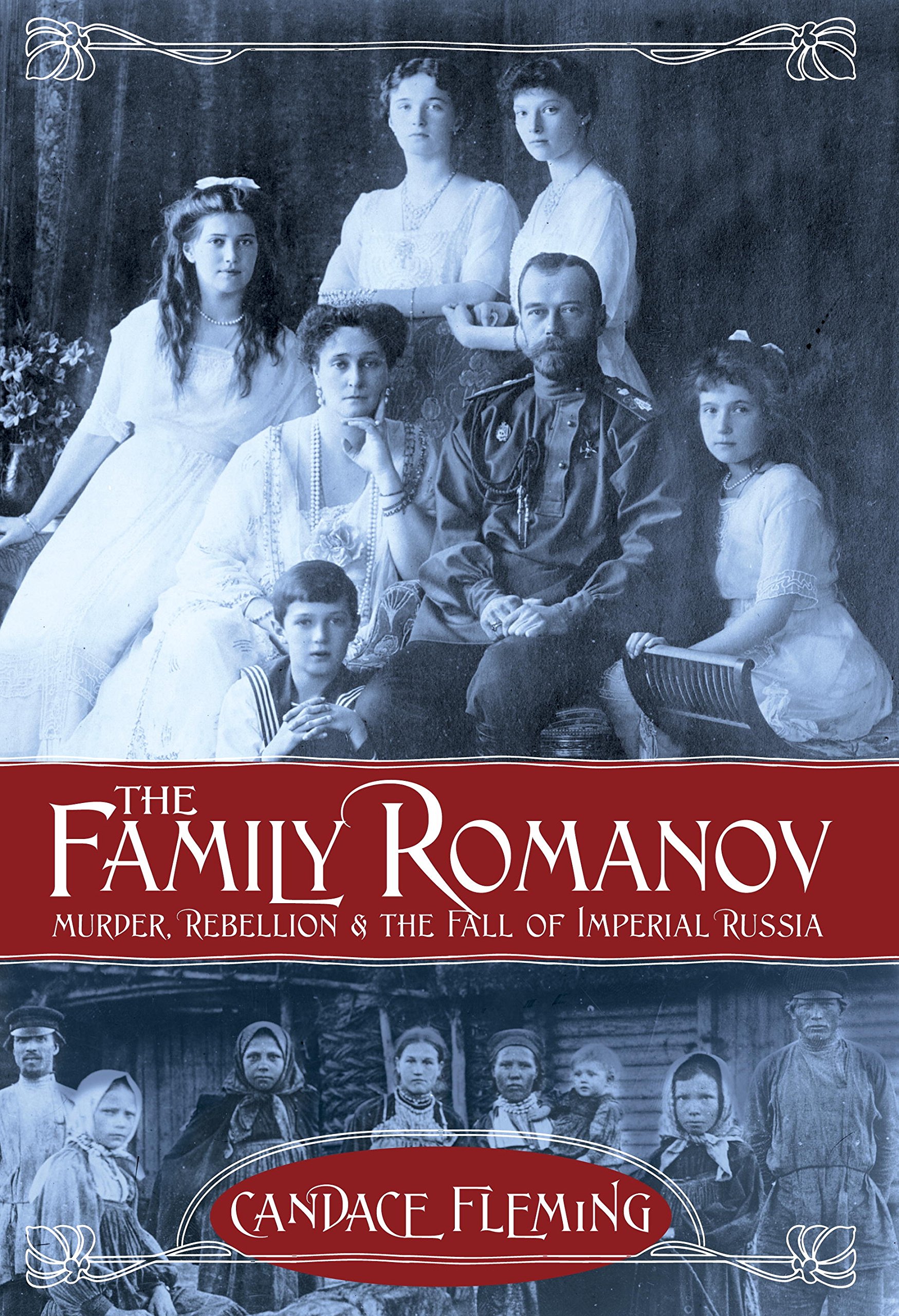
The Family Romanov: Russia, 1903–Beyond the Palace Gates
This award-winning book traces the history of the last royal family to rule Russia, the Romanovs.
Here are links to our lists for the book: Russia, 1903–Beyond the Palace Gates; Part One; Part Two; Part Three; Part Four
40 words
216 learners
Learn words with Flashcards and other activities
Definition First

Other learning activities
Full list of words from this list:
-
sable
the expensive dark brown fur of the martenBundled in sable, ermine, or mink wraps, the passengers alighted.
-
ermine
the expensive white fur of a small mammalBundled in sable, ermine, or mink wraps, the passengers alighted.
-
pomade
apply oil or ointment to the hairHanding their furs to the waiting footmen, guests paused in front of the pier glass to straighten silk skirts and pat pomaded hair into place before ascending the wide marble staircase to the second floor.
-
gilded
made from or covered with goldA series of halls, each more grand than the last, met the guests. Gilded ceilings and doorways.
-
opulent
rich and superior in qualityThey felt completely at ease in their opulent surroundings.
-
vellum
fine parchment prepared from the skin of a young animalWeeks earlier, the court runner had hand-delivered a stiff vellum card embossed with the imperial insignia—the gold double-headed eagle—to their palaces.
-
emboss
raise in a reliefWeeks earlier, the court runner had hand-delivered a stiff vellum card embossed with the imperial insignia—the gold double-headed eagle—to their palaces.
-
insignia
a badge worn to show official positionWeeks earlier, the court runner had hand-delivered a stiff vellum card embossed with the imperial insignia—the gold double-headed eagle—to their palaces.
-
caftan
a long cloak with full sleevesGiddy with excitement, the nobility flocked to dressmakers and tailors, where they spent fortunes on gold silk tunics, caftans edged in sable, and headdresses studded with rubies and diamonds.
-
bauble
cheap showy jewelry or ornamentGrand Duke Michael, Nicholas’s younger brother, even borrowed an egg-size diamond from the crown jewels to adorn the cap of his costume. (During the festivities, the priceless bauble fell off his costume and was never found.)
-
fanfare
a short lively tune played on brass instrumentsAt precisely eight o’clock came a fanfare from the state trumpeters.
-
imposing
befitting an important, distinguished, or powerful personShort, with a neatly trimmed beard and large, soft blue eyes, Nicholas hardly looked like the imposing ruler of Russia.
-
unassuming
not arrogantAnd yet this unassuming man reigned over 130 million subjects and one-sixth of the planet’s land surface—an area so vast that as night fell along the western edge of his territory, day was already breaking on the eastern border.
-
levy
impose and collectEvery year he drew an income of 24 million gold rubles ($240 million today) from the state treasury, which derived most of its income from taxes and fees levied on the tsar’s subjects.
-
piety
righteousness by virtue of being religiously devoutDressed as Alexei the Mild (the gentle seventeenth-century tsar whom Nicholas nostalgically admired for having ruled, he believed, during a time of piety and morality), he wore a raspberry velvet caftan embroidered with gold thread, its collars and cuffs flashing with diamonds.
-
brocade
thick expensive material with a raised patternAlexandra was wearing a gold brocade gown shimmering with the thousands of diamonds and pearls that had been sewn onto it—a costume that cost one million rubles ($10 million today).
-
pomp
ceremonial elegance and splendorWith the imperial couple’s arrival, the court orchestra broke into a polonaise, which was the traditional first dance, and Nicholas and Alexandra led the dancing with “appropriate pomp,” recalled one grand duke, “though [they were] hardly full of enthusiasm.”
-
autocrat
a cruel and oppressive dictatorEven though he was “Emperor and Autocrat of All the Russias,” as he was formally called, Nicholas often felt shy in society, while Alexandra acted nervous and awkward.
-
epaulette
an ornamental cloth pad worn on the shoulder“The whirl of the waltz [puffed out] the skirts,” recalled the French writer Théophile Gautier, who’d attended a ball at the palace two years earlier, “and the little gloved hands resting on the epaulettes of the waltzers looked like white camellias in vases of massive gold.”
-
decanter
a bottle with a stopper; for serving drinksAs guests ate, servants bustled about serving wine and cognac from crystal decanters and coffee from engraved silver pots.
-
spire
a tall tower that forms the superstructure of a buildingBut beyond the golden glow of the Winter Palace, across its graceful courtyard and through its gilded gates, past mansion-lined avenues and the spires and domes of the city, lay the railroad tracks.
-
steppe
an extensive plain without treesFarther and farther across the frozen darkness they stretched, over silent steppes and across mountains to thousands of scattered villages where primitive log huts clustered around rutted dirt roads.
-
ensconce
fix firmlyThey didn’t visit the peasants’ villages or deal with the hired laborers who worked their estates. Instead, they remained comfortably ensconced in luxurious St. Petersburg.
-
staple
a necessary commodity for which demand is constantOften, there was little to eat but dark bread. It was a staple of their diet, and peasant housewives tried to stretch the loaves by mixing clay, ground straw, or birch bark into the flour.
-
squire
an English country landownerRemarked one nobleman, “Every single peasant believed from the very bottom of his soul that one day, sooner or later, the squire’s land would belong to him.”
-
loll
be lazy or idleBeggars stood on every corner; drunkards lolled in every doorway.
-
ply
apply oneself diligentlyGangs of pickpockets, usually children, flitted through the crowds while prostitutes (many of them village girls who’d been unable to find work) plied their trade.
-
tenement
a run-down apartment house barely meeting minimal standardsFor these efforts, a worker earned around eighty kopecks a day (forty cents), hardly enough to support himself when just a loaf of bread cost twenty-four kopecks and a two-room tenement without water, kitchen, or toilet cost more than an entire month’s wages to rent.
-
noxious
injurious to physical or mental healthAt the same time, children coughing through the haze of noxious fumes in Moscow’s match factories earned a mere seventy cents a month!
-
recourse
something or someone turned to for assistance or securityIf workers thought their jobs were too dangerous, or their hours too long, they had no recourse.
-
sovereign
greatest in status or authority or powerThus, explained one worker, “The factory owner is the absolute sovereign...constrained by no laws, and who often simply arranges things to suit himself. The workers owe him unquestioning obedience as the rules [of the factory] proclaim.”
-
constrain
restrictThus, explained one worker, “The factory owner is the absolute sovereign...constrained by no laws, and who often simply arranges things to suit himself. The workers owe him unquestioning obedience as the rules [of the factory] proclaim.”
-
meager
deficient in amount or quality or extentSince their meager pay did not keep up with the rise in the price of goods, workers lived on a diet of cabbage soup, dried peas, and sour black bread.
-
squander
spend thoughtlessly; throw awayAt the neighborhood taverns, they tried to drown their misery by squandering precious kopecks on cheap vodka and watered-down beer.
-
hovel
small crude shelter used as a dwellingCompared with village hovels, what struck me about the houses of Moscow was their grandiose appearance, the luxury.
-
grandiose
impressive because of unnecessary largeness or magnificenceCompared with village hovels, what struck me about the houses of Moscow was their grandiose appearance, the luxury.
-
acrid
strong and sharp, as a taste or smellThe courtyard had an acrid stench...[and] throughout...were dirty puddles of water and discarded vegetables.
-
inexplicable
incapable of being explained or accounted forMy delight was beginning to turn into depression, into some kind of inexplicable terror....
-
bumpkin
a person who is awkward, uncultured, or unsophisticatedAwkward, sluggish, with long hair that had been cut under a round bowl, wearing heavy boots with horseshoes, I was a typical village youth. The skilled workers looked down on me, called me a “green country bumpkin” and other insulting names.
-
dexterous
skillful in physical movements; especially of the handsThen began the furious hunt with spoons for the floating morsels of meat. The most dexterous would come up with the most....
Created on 十月 14, 2020
(updated 十月 26, 2020)
Sign up now (it’s free!)
Whether you’re a teacher or a learner,
Vocabulary.com can put you or your class
on the path to systematic vocabulary improvement.